What Size Charge Controller for 500w Solar Panel
Size a controller for 500W of solar using battery voltage, charging current, and the array’s input limits.
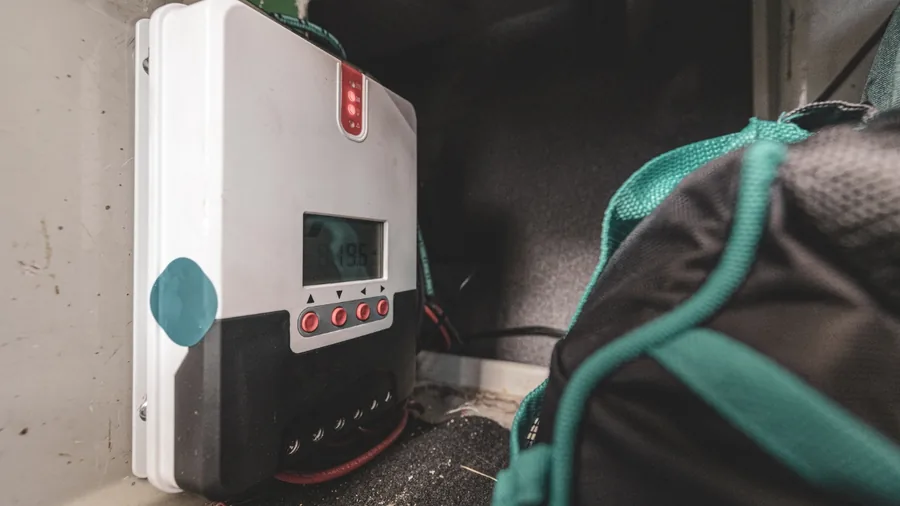
For a 500W solar array charging a 12V battery system, a suitable 50A MPPT controller is a common starting point. For a 24V battery system, a suitable 30A MPPT controller may have ample output capacity. Those are starting categories, not permission to connect any 500W panel to any controller with the right amp number.
You also need to check the array's voltage and current, the controller's published PV limits, and the battery's charging requirements. A few minutes with the specification sheets can prevent a surprisingly expensive mismatch.
Why Battery Voltage Changes the Answer
Power is approximately voltage multiplied by current. Rearranging that relationship gives current as power divided by voltage. For a basic estimate, 500W divided by 12V is about 41.7A. At 24V, the same power corresponds to about 20.8A.
Charging voltage is higher than nominal battery voltage in many systems. Using 14.4V as an example gives about 34.7A, while 28.8V gives about 17.4A. These figures illustrate the relationship; they are not universal charging settings for every battery.
Real controllers have conversion losses and operating limits. Select equipment from its actual specifications rather than assuming a calculation at one convenient voltage describes every operating condition.
What MPPT Changes
An MPPT controller can operate the solar array at a suitable input voltage and convert available power to battery charging voltage. That is why a panel producing a relatively modest input current can result in a larger current on the lower-voltage battery side.
A PWM controller works differently. You should not assume a high-voltage 500W panel will deliver its rated power through a basic PWM controller into a 12V battery. Panel voltage and battery voltage must be matched appropriately for that arrangement.
For many modern 500W arrays, an MPPT controller is the practical category to investigate. The correct model still depends on how the panels are wired and what battery system you are charging.
A Real Specification Example
The Victron SmartSolar 100/30 and 100/50 specifications make the distinction clear. The 100/30 has a 30A rated charging output and lists nominal PV power of 440W at 12V or 880W at 24V.
The 100/50 has a 50A rated output and lists 700W at 12V or 1,400W at 24V. Both list a maximum PV open-circuit voltage of 100V, but their permitted PV short-circuit currents differ.
In that particular range, the 100/50 is a more natural starting point for 500W on a 12V battery. The 100/30 can fit the power requirement at 24V, provided all the other limits and battery requirements are satisfied. These examples are not specifications for every brand's 30A or 50A controller.
Check Open-Circuit Voltage First
The array's open-circuit voltage, usually written Voc, must remain within the controller's input limit. Do not compare only the operating voltage shown in a product listing.
Solar panel voltage can rise in cold conditions. Use the panel's temperature coefficient and the appropriate minimum design temperature to check the cold-weather maximum. This matters in Alberta even if your usual camping trips happen in milder weather.
If the cold-weather calculation approaches or exceeds the controller limit, change the design or choose appropriately rated equipment. Do not rely on a controller to harmlessly discard excess input voltage.
Series and Parallel Change Different Things
Connecting panels in series adds their voltages while the string current remains governed by the panels in that string. Connecting suitable strings in parallel adds current while keeping the operating voltage broadly at the string level.
For example, two panels with a 30V open-circuit rating would have approximately 60V combined Voc in series before temperature adjustment. In parallel, their combined open-circuit voltage would remain around 30V, while available current increases.
Those are simplified examples using matching panels. Mixed panels, shading, connector ratings, and required protective devices can complicate the design. Write down the intended arrangement before checking the controller limits.
Do Not Ignore Input Current
A controller's output amp rating does not tell you its maximum permitted PV short-circuit current. Check both. The array's Isc rating and wiring arrangement matter even when the total wattage looks acceptable.
Some manufacturers permit particular forms of panel oversizing that cause output clipping under strong sunlight. That does not mean every input limit can be exceeded. Voltage limits and short-circuit current limits remain separate requirements.
Use the manufacturer's permitted sizing method. If the manual does not clearly support the proposed array, ask the manufacturer or have a qualified installer review the design before connecting it.
Match the Battery and Wiring
Check battery chemistry, charging voltage, maximum charge current, and temperature restrictions. A controller capable of producing 50A should not automatically be allowed to send 50A into a battery that requires a lower limit.
Use suitable cable sizes, fusing, disconnects, terminals, and installation clearances. Cable sizing depends on current, distance, installation conditions, and applicable requirements. A generic wire size copied from a different system is not a complete design.
Follow the connection and disconnection sequence in the controller manual. Some equipment needs to detect the battery system before receiving PV input. Correct sequencing is another reason to keep the actual manual with the installation.
Controller selection is easier once the battery and daily charging target are known. Work through the 100Ah battery example or the broader RV battery charging guide, then return to the controller specifications.
Frequently Asked Questions
Is a 40A controller enough for 500W at 12V?
It may be supported by a particular manufacturer, but the amp calculation alone is insufficient. Check its rated PV power at 12V and every input limit. A suitable 50A model often gives a more straightforward selection.
Does 100/50 mean a 100V battery?
No. In the Victron example, those numbers refer to the maximum PV voltage and rated charging current. Supported battery voltages are listed separately.
Should I buy extra capacity for later?
Only with a realistic expansion plan. Future panels may change array voltage and current as well as wattage. Plan the final arrangement rather than assuming a larger output amp number will accommodate any addition.